“Love You, W**ker.”
Genius brand building – or lad culture on life support?
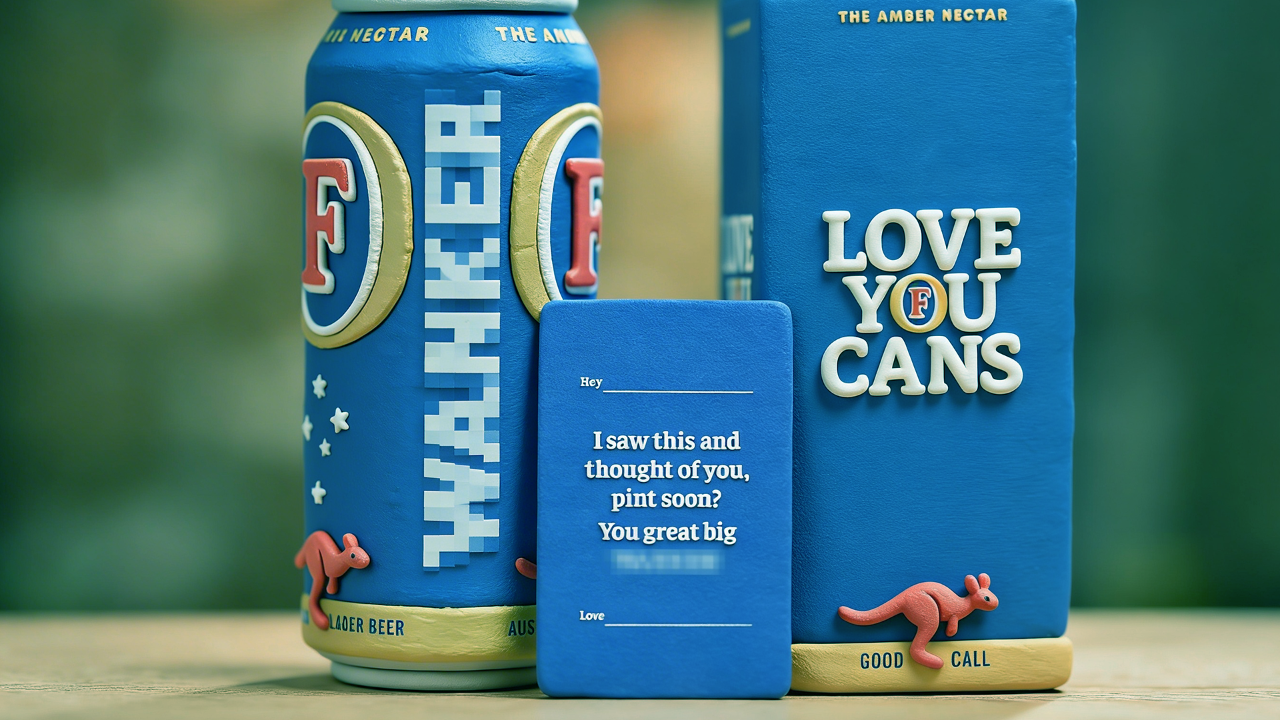
Foster’s have just dropped a new campaign called Love You Cans and, instead of inspirational slogans or limited-edition graphics, the cans are printed with words like w**ker, kn**head, and be**end. Not exactly Hallmark material, is it?!
The idea is built on new research suggesting many British men struggle to say the sentimental stuff out loud, but are perfectly comfortable expressing affection through mock insult. It seems they're increasingly losing touch with their friends and admit that reaching out can feel awkward, whereas many find it easier to express affection through mock insults. A whopping 59% of British millennial men say calling their mates a crude nickname is how they show that they care... I think I may be one of them!
In other words, "banter" is the bridge.
Now you can look at this and roll your eyes. You can call it dated, laddish, tone-deaf. Or you can step back and ask a more interesting question:
Is this actually bloody good marketing?
I think it is.
And more importantly, I think it’s an example of doing marketing properly.
Diagnosis: spotting what's already there
Whether we like it or not, there's a social code at play in certain male friendship groups where affection is disguised as insult. If you’ve ever stood in a pub listening to a group of blokes greet each other, you’ll know the script. It sounds hostile to an outsider, but within the 'tribe' it signals closeness.
Foster’s didn’t invent that behaviour. They observed it and anchored themselves to it.
That’s the bit people often skip. This isn’t random shock value. It’s cultural observation turned into packaging. It starts with understanding how people actually behave, not how we’d prefer them to behave.
Segmentation and targeting: not for everyone
This campaign isn't trying to resonate with every demographic slice of the population. It is clearly aimed at a particular social group and a particular context - pub occasions, sport, reunions, that slightly awkward reconnection after a while apart.
Too many brands dilute themselves trying to be universally palatable which, more often than not, leads to something bland and forgettable.
Foster’s have done the opposite here. They’ve leaned into a truth that belongs to a segment and trusted that segment to get the joke. That’s focused targeting. It doesn’t require universal applause; it requires cultural fit with the right people.
It's proper targeting.
Positioning: staying in character
Imagine a delicate, premium craft lager attempting this and you’d possibly feel the gears grinding. It might feel trite, cliched and a bit forced.
But Foster’s has long occupied that easygoing, self-aware, slightly irreverent space. They haven’t pivoted into something they’re not. They’ve expressed affection - but in a tone of voice that's inimitably theirs. When brands abandon who they are to chase relevance, the audience senses it immediately. This feels consistent rather than opportunistic. It feels like Foster’s.
That’s proper positioning.
Category Entry Points: scripting the moment
Beer is deeply occasion-driven. Match day, barbecues, after-work drinks, long-overdue catch-ups.
What Foster’s have done is attach themselves to a micro-moment within those occasions - the reconnection. The slightly awkward “love you, mate” moment that needs softening.
The can becomes a prop. If you like, a safe way to say something affectionate without actually saying it.
That’s neat category entry point thinking. The brand isn’t just present at the occasion, it's helping to script it.
The cultural question
Of course there will be criticism. Some will argue that "lad culture" has long-since had its day, or that brands should be nudging "toxic masculinity" in a softer direction. Those are fair debates.
But there’s also a danger in sanding every edge off a brand in pursuit of universal approval. When everything is polite, safe and inoffensive, it’s also invisible. There’s a big difference between glorifying something problematic and knowingly reflecting a social dynamic that already exists.
From what I’ve seen, this feels self-aware rather than aggressive. It’s definitely a wink, not a snarl.
Where I land...
I think this is very smart. It shows strong diagnosis, clear targeting and consistent positioning, just as Kotler taught us... It’s not chasing a trend for trend's sake. It feels far more 'strategic'. Choosing who it's not for every bit as much as who it is for.
Is it risky? Slightly.
Is it divisive? Probably.
Is it strategically coherent? Yes.
But what do you think? Is this sharp brand building, or has Foster’s misread the cultural mood?
And to whoever signed this off… fair play, you massive t**ser!