When Your Brand's Made From Girders, It Takes Big Stones To Leave It Alone.
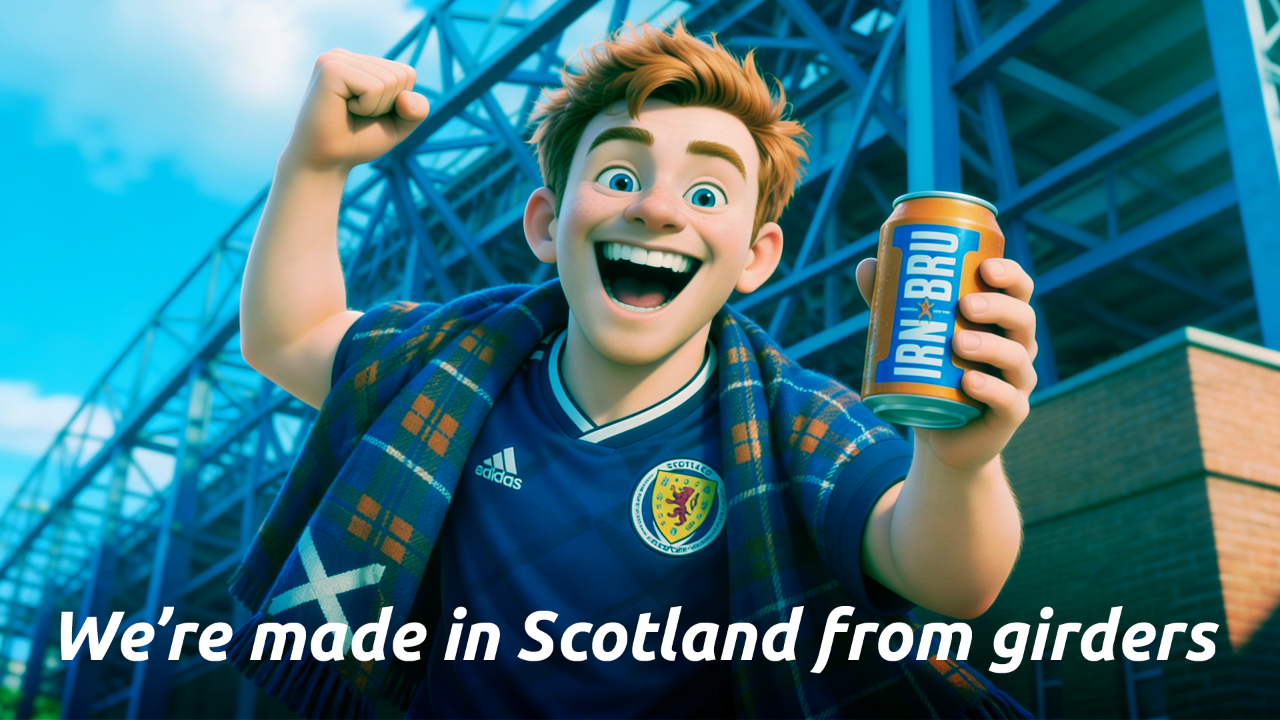
Scotland haven't been at a World Cup since 1998... Twenty-eight years of hurt, hope, near misses, and the particular brand of gallows humour only a football nation with genuinely low expectations could sustain. So having finally qualified for 2026, the question for every brand in Scotland is now the same: how do we show up for this moment?
Most will adopt the same old clichés... they'll dust off a Scottish flag, write "come on Scotland" in their brand font, and call it a campaign. But Irn-Bru have done something else entirely.
They taken a jingle they've been using since the 1980s and turned it into a full-blown terrace anthem. It features a brilliantly funny/ironic self deprecating cast: Susan Boyle, John McGinn, Franz Ferdinand frontman Alex Kapranos, comedian Paul Black and even seventy-one-year-old viral sensation May Miller. Its lyrics are about ticket prices, airport security, America's 'weirdness', and a nod towards their hopeful talisman John McGinn. It's been shot across Glasgow and Loch Lomond, released on Spotify, pressed to vinyl, and plastered across airport departure lounges. It's like a genuine music release that just happens to also be a "soft" drink ad.
I think it's one of the best pieces of branded creativity you'll see this year... and here's why:
This isn't a football ad, it's a positioning ad.
Most brands see a cultural moment and ask themselves 'how do we attach ourselves to this'? Irn-Bru have asked a very different question: 'how do we be ourselves in this moment'?
The World Cup hasn't change their positioning, it's given them a stage. That's the difference between a brand that owns a space and one that simply rents it for the bandwagon ride (one might say a "brandwagon"). Renting looks like your logo on a kit and a flag emoji. Ownership looks like this.
Don't touch the girders thing.
"Made in Scotland from Girders" has been running since the '80s. The marketing team will have had this conversation dozens of times across those four decades: shouldn't we freshen it up? Isn't it a bit dated?
Every time, their answer has been: "don't f***ing touch it!"
Jenni Romaniuk at the Ehrenberg-Bass Institute calls these distinctive brand assets - the sensory cues that make a brand instantly recognisable without announcing itself. The more consistently you deploy them, the more deeply embedded they become. The error most marketers make is confusing their own familiarity with the asset for the customer's. You've been staring at the same logo for three years. You're bored. Meanwhile your customer has probably seen it four times in their lifetime and has barely registered it.
Irn-Bru have understood this for decades. This campaign doesn't revive the girders line, it amplifies it. It's new creative deployment of exactly the same DNA... and it's brilliant!
Why the sonic element is the most underrated part of this.
A lot of the conversation will focus on the visuals, the cast, the copywriting. All of which deserve plaudits. But the most powerful creative decision was making the brand asset a proper footy anthem.
Think about what happens when a familiar piece of music plays. It doesn't take the rational, deliberate path, it bypasses it entirely. Daniel Kahneman described two modes of thinking: System 1, which is fast, intuitive and emotional, and System 2, which is slow, rational and effortful. A sonic brand asset is one of the most direct routes into System 1 thinking that exists. Before your rational brain has evaluated anything, the jingle has already triggered a feeling: this is ours, this is Scotland, this is funny, this is us.
And being structured like a real song with a proper hook, it gets stuck in your head. You hum it. You share it. You hear it being sung at Glasgow Airport and you feel something that no amount of informational advertising could manufacture.
System1 Group consistently finds that campaigns with genuine emotional resonance dramatically outperform informational advertising on long-term brand effects. They're yet to test it, but I'd be amazed if this doesn't score exceptionally well. (UPDATE: Sytem1 have now released their World Cup Ad leaderboard and - as predicted - this ad has tested exceptionally well and is top of the leaderboard achieving a 5.9 Star Rating, the highest score possible)
The Long and Short of it, done properly.
Field and Binet spent years analysing IPA Effectiveness data and repeatedly found that the most effective brands do two things simultaneously. Emotional, broad-reach brand building at the top of the funnel, AND targeted sales activation at the bottom. Not one or the other but both together.
This campaign is structured exactly that way. The hero film and anthem is pure Long - no product claim, no call to action, just brand building at scale. The airport OOH, reactive social, meme executions and Spotify placement are the Short.
It's also worth noting the commercial ambition underneath all this. AG Barr have said explicitly that only 40% of Irn-Bru sales currently come from outside Scotland. So they're using this moment of peak mental availability to push into England and Wales with expanded distribution. The Long AND Short of it... Mental availability AND physical availability... working in concert at precisely the right moment. Diagnosis feeding strategy feeding tactics.
What they didn't do.
They could have made one of those wholesome documentary epics... you know those 'patriotic' tearjerkers with slow-motion montages and swelling strings? And it probably would have tested well... but it wouldn't have been Irn-Bru!
Instead they've leaned into irony, self-deprecation, and that inimitably Scottish humour that treats hope and low expectations as two sides of the same coin. Every creative decision has clearly been run through the same filter: is this us?
That discipline of knowing what you stand for and refusing to abandon it when a big moment arrives is much rarer than it should be, especially in hospitality. The brands that do it brilliantly understand the cultural moment is just a stage. What you perform on it still has to come from your own script.
The lesson?
Lucky Generals have earned their props again with this campaign, but Irn-Bru gave them something "iron-clad" (sorry) to work with - forty years of relentlessly consistent brand stewardship, knowing what their brand stands for, protecting assets that were already working, resisting the urge to fiddle... and this is the result.
When the World Cup opportunity arrived, the brand was ready. There was no scramble to define what Irn-Bru means. Everyone already knew.
And that's the real lesson for hospitality marketers. It's not about "being more creative", it's about positioning. It's about distinctive assets. It's about having the discipline to stay the course when you get bored of your own brand. If you do that work early enough and diligently enough, when the moment arrives, you can own it rather than rent it.
Want to understand how to build that kind of brand clarity for your own business? That's exactly what we cover inside The Academy. Find out more here.