Are you listening to your guests, or just keeping score?
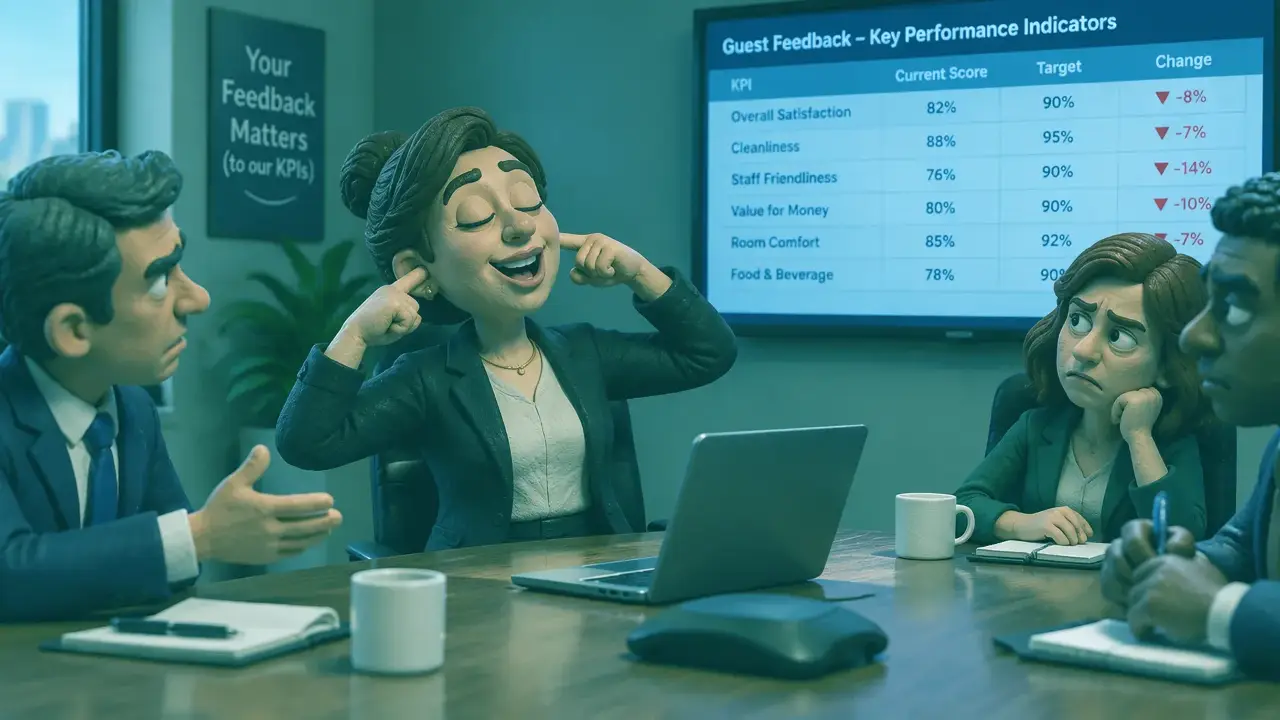
Hospitality businesses all like to think they value feedback and spend a fair amount of their time asking guests what they think. Guests are peppered with post-stay surveys, event debriefs, review requests and emails asking us to rate our experience, usually before we’ve even unpacked our bags! Somewhere, all those answers are being gathered into a report with pretty Excel tables and a satisfaction score that will hopefully turn green before the next management meeting.
But what are we actually using them for?
I suspect that, in some businesses, the main purpose is to provide a number for a KPI dashboard. We said we would measure customer satisfaction, we’ve measured it, and there it is on the dashboard. If the number goes up, everyone’s happy. If it goes down, someone has a well-rehearsed list of excuses... "Ah, but remember it was raining last Thursday. Everyone's grumpier when it's raining".
Others will go further and use the feedback to actually fix problems, recognise good service and improve what they deliver. Clearly, that’s a much better use of it. But, even then, I think we can be overlooking a massive part of its value, because customer feedback can help us do so much more than establish whether the breakfast was hot enough.
Used properly, it can inform our product improvement, our market research, our positioning and our market segmentation.
Here's how:
Start with their journey, not your departments
An overall satisfaction score might tell you whether customers were broadly happy, but it won’t necessarily tell you where you’re getting things right or what needs attention. A successful event can still have been unnecessarily difficult to arrange, and a lovely hotel stay can end with a billing dispute that takes the shine off everything preceding it.
If your survey follows your departmental structure, you might miss the problem. Sales gets a score, reception gets a score, catering gets a score, but nobody asks about the experience of being passed between them. The customer doesn’t care who reports to whom, they just want to get something done without having to explain it to three different people.
So start by finding out which interactions actually mattered to them. That journey begins way before they arrive: with the reason they needed a hotel or venue in the first place; their impression of whether you could meet that need; and the process of enquiring or booking. It continues through arrival, the stay or event itself, and whatever happens afterwards. Your car park signage and your invoice email are as much a part of that journey as your welcome at reception.
This is the approach I cover in Module 7 of my Academy, Executing on Product. Identify the meaningful touchpoints, build them into your feedback questions and ask customers to score them. My Touchpoint Calculator then brings those scores together, ranks them and shows the variation in responses as well as the averages, giving you a practical basis for continuous product improvement.
And, as with all laws of averages, it's the variation - or deviation - that matters more than the number itself. A consistently poor check-in experience suggests a different problem from one that some guests love, but others hate. Perhaps it changes with staffing levels, arrival times or the person on the desk. Perhaps your self-service kiosk is wonderfully convenient for one guest and a source of frustration for another. An average alone won’t explain the difference; it just tells you where to start looking.
The lower-scoring touchpoints give you somewhere to focus, while their importance to customers helps you judge your priorities. Fix the problem, keep measuring and see whether the change has worked. Then turn your attention to the next weakness, rather than treating the survey as a monthly verdict on an experience nobody gets round to changing.
There’s also a second job to do here: use those touchpoints to reinforce your positioning. If your promise is to take the stress out of organising events, that should be apparent in the proposal, the booking process, the arrival instructions and the final bill. A reassuring website followed by a confusing contract isn’t a particularly convincing demonstration of a 'stress-free experience'. Your positioning needs to survive contact with the product.
Listen for what you could stand for
The scores help you see how you’re doing but the words underneath can help you understand why it matters.
An organiser telling you that your team were helpful is encouraging. An organiser explaining that they could finally relax because they trusted your team to handle problems without embarrassing them in front of their colleagues tells you much more. You’re getting closer to the benefit they were buying, rather than simply the service you were selling.
That’s why a few thoughtful, open questions can be so valuable. What prompted the booking? What were they hoping to achieve? What nearly put them off? What made the biggest difference? And what would they have done if they hadn’t chosen you?
You’re looking for themes worth exploring, including strengths you might otherwise take for granted. Customers could repeatedly mention reassurance, feeling looked after or being able to switch off. Those qualitative answers can give you a starting point for quantitative research, with follow-up conversations helping you understand what customers mean rather than leaving you to interpret a line in a comment box.
In Module 2, Step Out of the Darkness, I describe qualitative research as a way to understand the qualities of something, and quantitative research as a way to measure it. The two should work together. Feedback and interviews can uncover a potential insight; a survey of the wider market can test how widely it applies and how much it matters.
So, if existing customers keep telling you that you give them confidence, you have something worth investigating. Do other buyers value that benefit? In what circumstances? Do they associate it with you, and how do they rate the alternatives? That could inform a far more emotional positioning than yet another claim about excellent facilities and friendly service.
But praise alone won't establish the thing(s) you can own relatively to your competitors. Customers might say lovely things about your staff and exactly the same things about three other venues. You need to establish both the relevance of the attribute and your relative strength on it, rather than promoting the nicest comment into a brand strategy.
It also helps to ask which alternatives they actually considered. Your comp set may make perfect sense in the revenue meeting, but the customer’s shortlist is the one that shaped their decision. It’s worth finding out whether the two are the same. Often, the customer's alternative might be completely outside of the category and something you would never have contemplated.
Learn about the person giving you the score
There’s another opportunity we miss when every question is about us: learning more about them.
Two organisers can book exactly the same meeting package for completely different reasons. One might arrange events constantly and want flexibility, speed and control. The other might have been given the job alongside their normal responsibilities and wants guidance and reassurance. Putting both under “corporate meetings” won’t help you understand those differences.
Questions about booking frequency, the occasion, budgets, priorities, frustrations and the way decisions are made can uncover the behavioural and attitudinal information behind the transaction. You can then look at the feedback through those different lenses. Are inexperienced organisers struggling with something regular bookers find straightforward? Do guests travelling for different reasons value different parts of the stay?
This connects directly with Module 3, Create Order Out of Chaos, and my Measure Meaning Matrix. When defining segments, we need variables that meaningfully influence purchasing behaviour and that we can practically measure. Your survey can help you investigate those variables and collect the data needed to place customers within the resulting groups.
Not every interesting answer needs to define a segment, though. Some information is more useful for fleshing out the persona within it: what these people worry about, what they value, what frustrates them and what they expect from you. That gives your commercial team a much more useful picture of the customer than a name and a stock photograph attached to sort of "archetype".
With the right questions, you can also put real numbers against the groups within your existing customer base. But don’t confuse that with measuring the whole market. A guest survey only reaches people who chose you, and its responses come from those who decided to answer. It leaves out the people who booked elsewhere and those who never considered you at all.
To estimate a segment’s share of the wider market, its population and its value, you need representative samples that represent the market. Your customer feedback can contribute to that work, help shape the questions and show how your current business fits the segmentation. It can’t fill in the entire picture on its own.
Decide what you’ll do with the answers
None of this is a suggestion to turn your post-stay survey into an interrogation. Customers have already given you their money and their time and shouldn’t need an afternoon off to tell you whether they enjoyed themselves.
The better starting point is to decide what you need to learn and what decision it will inform. That’s the principle behind working backwards when planning research in Module 2. If you want to improve a touchpoint, what do you need to understand about it? If you want to investigate a positioning opportunity, what would count as useful evidence? If you want to enrich your segmentation, which behavioural questions will let you make meaningful distinctions?
Keep useful tracking questions consistent, and use focused questions or follow-up research for the things you want to explore. You don’t have to squeeze everything into every survey, but you should know why each question is there. You should also know who will use the answer, because collecting something interesting isn’t much help if it never reaches the person who can act on it.
Operations needs the feedback that can improve delivery. Marketing needs to examine what it says about customer needs, alternatives, positioning and segments. The sales team needs to understand the implications, and somebody needs to take responsibility for the changes. For example, where you’ve acted on a customer’s suggestion or complaint, telling them what you’ve done is a fairly sensible way to demonstrate that answering was worth their while.
So yes, keep measuring satisfaction. But before the next survey goes out, ask what the last one helped you improve, what it taught you about your customers and what you’re going to investigate next.
If all it produced was a green box on a dashboard, I’d suggest your customers have done rather more work than you have.
Research, segmentation and product improvement are all covered in my Hospitality Marketing Academy, with practical tools to help you apply the thinking to your own hotel or venue. From my Measure Meaning Matrix to the customer Touchpoint Calculator, the aim is to help you use what you learn about customers to make better marketing decisions. Find out more about the Academy.