COQ AU VIN: Six branding lessons hospitality can learn from KFC's latest partnership
Hold the phone… KFC is opening a wine bar!?
Yes it is! Well, sort of.
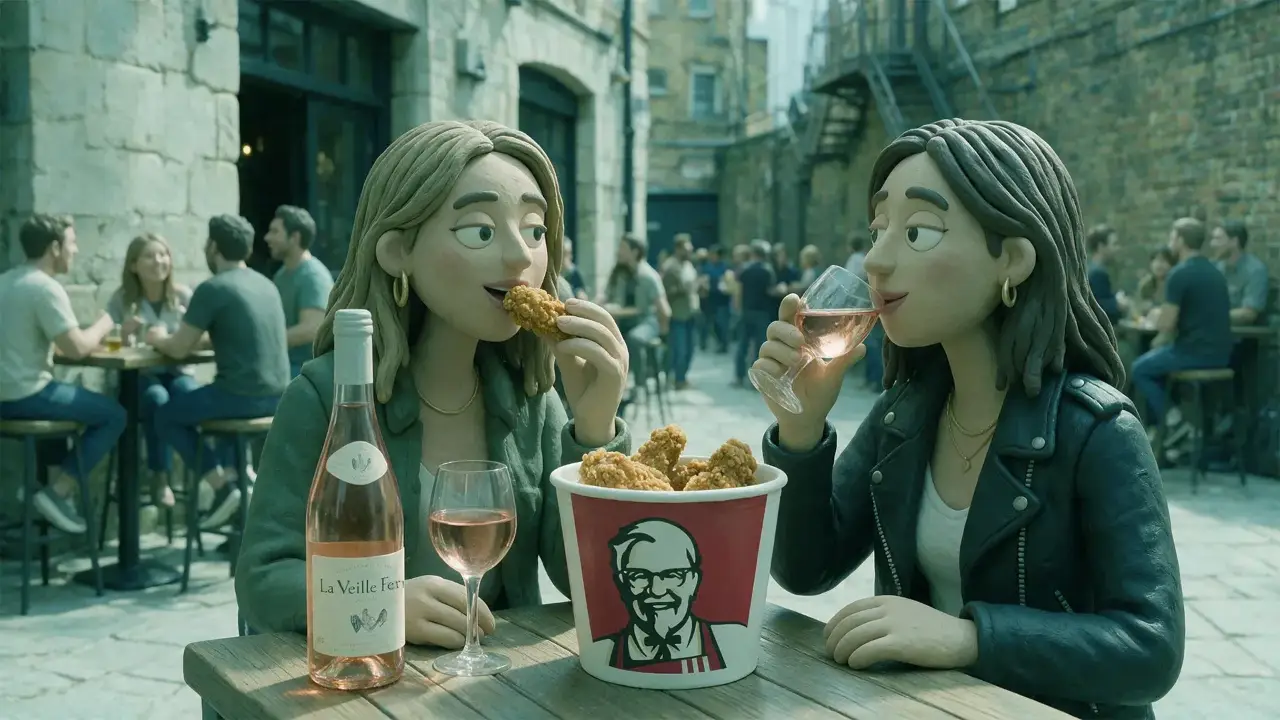
For four days over the August Bank Holiday, the fried chicken behemoth is taking over Kachette Annex in Shoreditch with La Vieille Ferme, the French wine most people affectionately know as the ‘Chicken Wine’.
They’ve called it Coq au Vin, because of course they have!
The pop-up pairs KFC Popcorn Chicken with sparkling rosé, Hot Wings with La Vieille Ferme Rouge, and Original Recipe Tenders with its rosé or blanc. Tickets cost £15 for a 90-minute sitting and, at the time of writing, have already sold out, although a limited number of walk-in spaces will be available.
There will also be a special edition ‘Chicken Wine’ label, available exclusively at the event.
On the face of it, it’s another slightly ridiculous brand collaboration designed to just get people talking. And it's certainly done that, if LinkedIn is anything to go by. But there’s a lot more going on here than just whacking two logos on something and issuing the obligatory press release.
This partnership began life a long time ago when consumers of a middle-of-the-road wine brand started calling it something easier to remember than GCSE French lessons. Instead of railing against it - as most brands would - they fully embraced it in an act of brand management brilliance. Their fantastic stewardship eventually enabled two brands with an obvious connection (but very different products and audiences) to forge a mutually beneficial brand partnership. Then, instead of limiting the idea to an advert or a limited edition label, they’ve turned it into a real experience people can visit, photograph and share.
I think there’s quite a lot hospitality marketers can learn from it...
Your customers get a vote
In case you didn't know (where have you been?), La Vieille Ferme isn’t actually called Chicken Wine.
The name translates as ‘The Old Farm’, but the label carries a prominent illustration of a rooster. British customers began referring to it as 'Chicken Wine' because it was easier to recognise, pronounce and ask for - especially when issuing instructions to your husband to 'pick up a bottle of chicken wine on the way home will you, love?'
The nickname spread through word of mouth and social media until, for many customers, it's become more familiar than the real name of the product.
La Vieille Ferme could have corrected them. It could have insisted on the proper French name and indignantly explained the heritage - and, as the French would say, 'terroir' - behind their beloved brand.
Instead, they went all in with it.
The brand adopted the Chicken Wine name for a limited edition release in 2024 and now even uses the nickname on its own website. After building loads of genuine brand salience and equity as a result, the KFC partnership simply takes that customer-created identity to its next logical conclusion.
Academics call this market orientation (I prefer customer centricity): understanding that you're not the customer; understanding what customers actually think, feel and do around your brand, not just what you hope they'll think, feel and do.
Similarly, the lager brand Corona didn’t invent the ritual of putting a lime in the bottle. Its customers did. The brand was dead set against the idea, insulted that people would need to add a wedge of lime to disguise the taste... until an anthropologist researcher at AB InBev begged them to keep it. You see, the one thing you don't do when customers have invented a ritual for your product/service is tell them they're wrong!
Hospitality brands are surrounded by similar clues and insights. Guests shorten names, develop rituals, photograph particular parts of the experience and use products/services in ways nobody foresaw in the Powerpoint strategy deck.
Not all of those behaviours will be commercially useful, obviously. But they are worth paying attention to, because customers don’t need your permission to decide what your brand means.
Positioning happens in the customer's mind
Marketers often talk about "positioning" as though it’s something written in brand guidelines - usually presented in clever concentric circles or rhomboids (you know who you are!).
Proper positioning is the place you intend your brand to occupy in the customer’s mind, relative to the alternatives. You can decide on the strategy, but the actual position can only exist in the mind of the customer.
Brand equity is built from salience multiplied by brand image. In other words, how readily the brand comes to mind and what people associate with it when it does.
La Vieille Ferme has a French name, a long winemaking heritage and links to the Perrin family. But its position among many UK customers is much simpler. It’s the affordable, approachable French wine with the chicken on the label. It doesn’t undermine the product; if anything, it's given people a very easy way to recognise, remember and recommend it... which is kind of the point of brand positioning!
KFC’s position is equally clear. It’s the fried chicken brand.
The Coq au Vin partnership works because neither brand has to become something fundamentally different than they are. KFC is still famous for chicken. La Vieille Ferme is still the wine people associate with a chicken. The partnership reinforces those positions but in a new and - more importantly - memorable way.
So, when a hospitality brand is considering a partnership or campaign, the question isn’t only whether people will notice it. It’s what they'll associate with the brand afterwards.
Attention is useful, but not if people remember the stunt and then forget who was behind it. The strongest ideas attract attention and attach the right associations to the brand.
Distinctive Brand Assets do most of the heavy lifting
Without the rooster on the La Vieille Ferme label, this collaboration probably doesn’t happen.
The bird has helped customers recognise the wine, created its popular nickname and allowed for the link to KFC. It isn’t just a nice bit of decoration, it's become their most important distinctive brand asset (DBA).
KFC brings an impressive DBA collection of its own: Colonel Sanders, the red and white stripes, the bucket, ‘Finger Lickin’ Good’, the typography and, above all, an almost unrivalled association with fried chicken.
Put the two brands together and you can understand the idea almost instantly... Chicken + Chicken Wine = Coq au Vin. It doesn’t need several paragraphs explaining the strategic rationale before it makes sense.
That’s why distinctiveness matters so much. It allows customers to identify a brand quickly and without much conscious effort (which is the reason brands exist in the first place).
Hospitality businesses have an unfortunate habit of becoming bored with their own brand assets long before customers have had the chance to learn them. Colours change, straplines disappear, photography styles are replaced and logos are ‘refreshed’ because somebody feels they’ve become too familiar.
But becoming familiar was the whole point!
Distinctive assets gain their value through consistent - no, relentless - use. The easier you are to recognise, the less work customers have to do to notice you, remember you and retrieve you when they’re ready to buy.
If it’s fried chicken, it has to be KFC. If it’s Chicken Wine, it has to be La Vieille Ferme.
The best co-branding creates value for both sides
Co-branding is when two established brands come together to create a product, service or experience.
It’s different from one brand simply buying advertising space from the other. Customers inherently understand that both names have contributed something, while remaining separate brands outside of the partnership.
When it's done well, there are several benefits:
The first is brand image synergy. The two brands need to have enough in common for the partnership to make sense, even if their products and audiences are completely different.
KFC and La Vieille Ferme are both familiar, accessible and unpretentious. Neither asks customers to take the product, or themselves, too seriously. The shared chicken association sets up the joke, but the similarity in attitude is what stops the partnership feeling forced.
Then there’s partner synergy. Each brand contributes something the other can’t credibly or operationally provide themselves.
KFC knows fried chicken. La Vieille Ferme knows wine production. Neither has to wander into the other’s category and pretend to have expertise it doesn’t possess or can't afford.
The partnership also gives each brand access to a completely different audience and occasion they otherwise wouldn't be able to access.
La Vieille Ferme will reach younger customers who wouldn’t normally consider ordering wine with fried chicken. KFC will find its way into a more grown-up social occasion than the one usually associated with a takeaway bucket.
Of course, that doesn’t mean everyone who visits this pop-up will suddenly change their buying habits. But it gives both brands a perfectly good reason to enter each other’s world (and help shape that intended position in the customer's mind).
There’s also a degree of protection for both brands. Nobody will leave Coq au Vin believing KFC has become a winemaker or La Vieille Ferme has opened a chain of chicken shops. People understand that it’s a collaboration and, once it ends, both brands will return to their own corners with their core identities intact.
So, the question shouldn’t just be whether another brand is famous enough to bring you some attention. You need to consider whether your brand images are compatible, what each partner contributes and whether the partnership creates something neither could make as convincingly alone.
Strong brands give businesses somewhere else to grow
Co-branding is one way for a business to move beyond its core product/service and start creating new revenue. Brand and line extensions are two others, although the terms are often confused.
A brand extension uses an established brand to enter a different product category.
For example, PizzaExpress selling pizzas and sauces through supermarkets is a brand extension. The products are no longer being sold as part of a restaurant visit, but they benefit from the quality, familiarity and Italian food associations the brand has already built (brand equity).
A line extension stays within the existing category but introduces another version of the product, often to reach a different target segment or price point.
Guinness 0.0 is a line extension. It remains within the beer category but gives Guinness a product for customers/occasions where alcohol isn’t wanted.
Both approaches allow a business to use its existing brand equity as an avenue for new growth. Naturally, building a completely new brand is difficult and expensive, but an established name already comes with awareness, associations and trust.
But careful - you can’t stretch that equity indefinitely.
A restaurant brand known for pizza might credibly sell pizza in supermarkets but it doesn’t mean it can put its name on any product it likes and expect customers to follow. The further an extension moves from the associations that made the original brand successful, the harder it becomes for customers to understand and also increases the potential risk to the parent brand.
Co-branding can be a safer way to test that distance. KFC doesn’t need to create its own wine brand or persuade anyone that Colonel Sanders was secretly a sommelier. La Vieille Ferme supplies the wine credentials, KFC supplies the chicken, audience and cultural reach.
It gives both brands the chance to explore a new occasion without permanently redefining either one.
For hospitality businesses, extensions can create new revenue streams and help pay for investment in the core operation. But they should grow from the associations the brand already owns, and not involve sticking a logo onto anything that might make money.
A good idea should be bigger than an advert
KFC and La Vieille Ferme could have released a photograph of a wine bottle next to a bucket of chicken and called it a 'collaboration'.
Instead, they’ve built somewhere people can actually go.
The physical pop-up gives the idea scarcity and exclusivity. It turns the partnership into an experience rather than a gimmick. It gives journalists something to cover, customers something to attend and creators something to film. It's multi-channel, integrated tactical execution.
The special label gives people something physical to photograph and potentially keep. The pairings turn the premise into a menu. The Shoreditch location helps make it feel like a cultural event rather than just a promotion running in every KFC restaurant.
All of that gives the campaign material that can travel through other channels.
The event produces PR coverage. The unusual pairings create social content. Limited availability creates urgency. The people who attend will produce more photographs and videos, which will extend the life of a four-day activation far beyond those who are able to visit it.
It’s proper integrated marketing communication in practice, just as Don Shultz taught us in the 90's.
Integration doesn’t mean lazily copying and pasting the same advert into every available channel. It means having a central creative idea that can be expressed in different ways, with each channel doing the job it’s best suited to.
Here, the pop-up provides the experience. PR provides reach and credibility. Social spreads the joke. The packaging makes it physical. Scarcity gives people a reason to act.
But it all points back to the same idea: the world’s most famous fried chicken has finally met Chicken Wine!
A partnership that was waiting to happen?
Phoebe Syms, Fame and Partnerships Lead at KFC UK and Ireland, described Coq au Vin as ‘one of those partnerships that just makes sense’.
She’s right, although making sense isn’t quite the same as being obvious.
This campaign has been forged over time to work so well because La Vieille Ferme paid attention when customers renamed its product. Both brands have built strong, distinctive associations; each partner contributes something credible. And the campaign has been created as an experience, not just announced as a partnership.
The result is funny, memorable and easy to explain. More importantly, it makes both brands more recognisable for exactly what they were already known for.
And that's the power of a great partnership. It's not about turning your brand into something it's not... it's about making what's already distinctive about you even harder to forget.
Want to understand how to improve your brand equity? That's exactly what you'll cover inside The Academy. Find out more here.