Nobody's booking. Quick, make it cheaper.
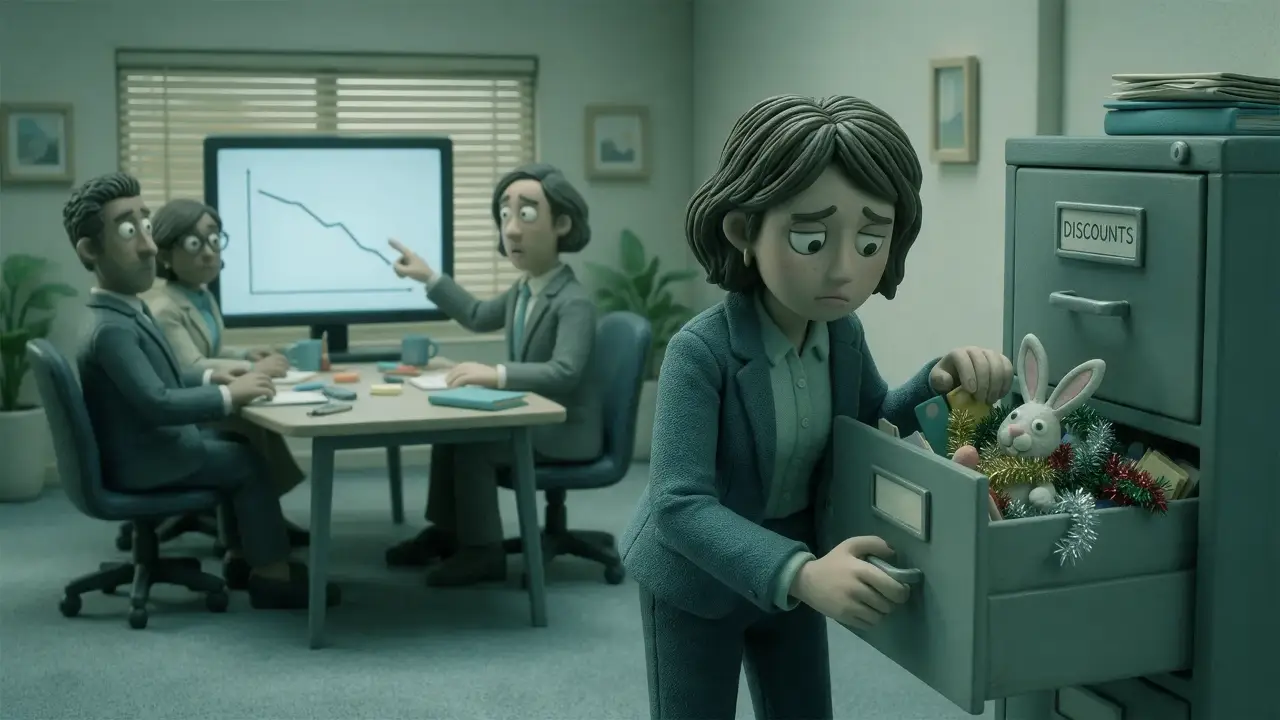
Have you ever been in a commercial meeting when somebody puts a disappointing forecast on the screen and everyone starts looking at marketing? Next month needs a boost, the restaurant is quieter than it should be, or there are rather too many gaps in the conference diary... Something needs doing, usually before lunch, and some bright spark has just the thing up their sleeve: a special offer.
Within hours, an email is being assembled announcing 20% off, accompanied by a photograph of an attractive couple enjoying themselves considerably more than the marketing manager. There’ll be a deadline, obviously, because this is an exclusive, limited-time deal... much like the one we sent last month.
What there may not have been is much discussion about why people weren’t booking in the first place, or how many additional customers the business will need to recover the money it’s about to give away.
Discounting like this seems to be seductive because it feels decisive and produces results we can see. Bookings turn up in the system, promotional codes get counted up and the forecast starts to look a little healthier. Whether the business is actually better off requires a slightly less comfortable conversation.
Congratulations. You’re busier.
One of the arguments I make in the pricing module of my hospitality marketing Academy is that we spend far too much time celebrating 'revenue' without properly examining what it took to earn it. A fuller hotel might be good news, but occupancy on its own doesn’t pay the bills.
This is such an important point: price has a particularly powerful effect on profit. Selling more volume brings extra costs along with it, while an increase in price on the same sales can improve the margin without having another bedroom to service or another meal to prepare. If a business turns over £1 million and makes £100,000 operating profit, a 5% increase in its prices would add £50,000 to that profit if sales volumes and costs stayed the same. That’s a 50% improvement in profit from a 5% change in price. The difficult bit, of course, is understanding whether customers will still buy at the higher price.
Discounting pulls that same lever in the opposite direction, which is why a seemingly modest reduction can leave such a large hole. Yet we often treat the price as the easiest thing to sacrifice and ask the sales team to make up the difference through sheer effort. Before anyone announces that we’ll make it up with volume, you should establish exactly how much volume they have in mind!
Suppose a hotel is selling a bedroom for £175 and - for the sake of argument - it has a 10% margin/contribution. In other words, the room contributes £17.50 after costs. Now, somebody suggests a modest 5% offer to try and stimulate demand and encourage bookings. That takes £8.75 off the room rate which (assuming you haven't docked Housekeeping's wages accordingly) is half the profit we were making. Instead of earning £1,750 from selling 100 rooms, we now need to sell 200 to make the same money. That’s double the sales volume just to stand still! Quite the assignment to hand over to the sales team on a Monday morning!
The danger with discounting is that the extra activity looks like success. Everyone's working harder and the hotel is fuller than it was. But if all that effort only earns the same profit as we were making before, what exactly are we celebrating?
The bookings you were going to get anyway
There’s another problem with discounts. Knowing how many people used an offer doesn’t tell us how many needed the offer to book.
A couple who had already decided to visit your restaurant will quite happily use the voucher that lands in their inbox. A conference organiser who was ready to confirm might be delighted when the salesperson volunteers a lower delegate rate. Both will appear in the results, although the business may simply have surrendered money the customer was willing to pay.
Recent work presented by Les Binet and Kantar’s Dom Boyd at the IPA Effectiveness Conference, Kicking the promotion habit, examines why businesses keep reaching for promotions despite their commercial risks.
Their new study surveyed 250 UK marketing leaders. Among respondents responsible for planning, approving or evaluating sales promotions, 82% judged their latest one profitable, yet 75% couldn’t say what proportion of their previous ones had been profitable. It also shows that 76% of them repeat sales promotions when profit hasn’t been properly assessed.
Does that sound familiar? How many of us run a sales promotion or a flash discount without having the first idea of the impact on profit, let alone whether the promotion was the thing that the customer needed to commit to purchase?
Their wider findings also distinguish additional sales from purchases shifted in time or taken from elsewhere in the business. For hospitality, that might mean a guest moving a planned stay into a sale period, or a diner using a discounted package instead of ordering from the usual menu. The promotional code records a response, but it doesn’t establish what would have happened without the offer.
Teaching customers to wait
A one-off discount can look like a pleasant surprise. But a discount that arrives with the regularity of the fire alarm test starts becoming part of the customer's buying process.
Customers aren't stupid. They learn. If your hotel or venue keeps announcing 20% off, anyone with flexibility now has a reason to delay booking until the next email arrives. The advertised rate may still be the £175, but your promotional £140 starts to feel like the sensible price to pay. Meanwhile, the customer who paid £175 is left wondering whether their loyalty has earned them anything beyond the privilege of subsidising everyone else.
There’s also a question of what the price says about the product. Hospitality businesses spend considerable effort persuading people that their offering is worth choosing, then devote much of their communication to explaining how cheaply they can have it. A restaurant with an excellent chef can gradually become known for its vouchers rather than its food.
The bookings may keep coming, but the business becomes dependent on giving people a deal. When the next forecast looks weak, another promotion feels unavoidable, partly because previous promotions have helped create the expectation. Eventually, somebody suggests the discounts need to be bigger.
Make it worth paying for
The correct alternative is to start with understanding what’s preventing the booking in the first place. If an event organiser hasn’t shortlisted your venue because they don’t know it exists, reducing the delegate rate won’t address the problem. If they’re worried about whether your team can manage a complicated event, a cheaper proposal will do less than a conversation with the person who’ll help them deliver it would.
Price matters, of course. Customers have budgets and sometimes the price really is the barrier. But a price objection can also mean that someone hasn’t seen enough value to justify paying it. Those are different problems, and reaching straight for a discount before understanding which one we have is an expensive way to avoid finding out.
In my Academy, I teach Van Westendorp’s price sensitivity meter, which explores the range from so cheap that people question the quality, to so expensive that they would rule it out. Now, we don’t need to turn this article into a research tutorial, but that “too cheap” question deserves a moment’s attention. Lowering a price doesn’t automatically make something more desirable. It can also make people wonder what’s wrong with it, particularly when they’re trusting you with an important occasion.
It's also worth thinking about the distinction between price as a noun (the number itself), and pricing as a verb (the work involved in researching, setting and presenting the number). Suffice to say, we can influence how a price is understood, as well as change what it says. If all our effort goes into making the number smaller, we’re ignoring a considerable part of the job.
A conference organiser comparing delegate rates may see little reason to pay more until they understand what your package includes and how much work it takes off their plate. A wedding couple may find a higher price easier to accept when the proposal makes the support and reassurance tangible. Presenting that value clearly can change the decision without taking a penny off the price. Equally, if there’s nothing meaningful to justify the difference, a prettier proposal won’t invent it.
My plea is to always look for ways to add value before cutting the price. A late checkout might make a weekend break more appealing to someone who wants a properly lazy Sunday. Including something useful in a conference package could remove an organiser’s worry or save them work. The opportunity is to find something customers value more highly than it costs us to provide.
Let's take our £175 bedroom example and imagine someone has suggested a 10% off promotion. Rather than taking £17.50 off the rate, what happens if we keep it at £175 and instead include a £17.50 voucher for the bar? The guest has something extra to enjoy, and the room retains its price. The cost of providing the drinks is likely much lower than the £17.50 we would otherwise surrender, and the visit to the bar might lead to further spending.
Now that's not to pretend that the voucher costs nothing. If the guest would have spent that £17.50 in the bar anyway, we may simply be giving away existing revenue somewhere else. The advantage obviously depends on what they redeem, the cost of serving it and whether their behaviour changes. But it gives us a far more useful commercial question than “shall we do ten or twenty per cent this time?”
This is why marketing belongs in pricing conversations. Revenue colleagues bring expertise in demand, inventory and rates; marketers should contribute evidence about what customers value and how the offer is understood. That contribution starts before the rate is agreed, with insight into the reasons people choose us and what they’re prepared to pay for. Being handed an agreed discount and asked to make it look exciting falls a long way short of the commercial value marketing should be bringing to the business.
The aim is to earn the right to charge properly. That means offering something customers value, making that value clear and resisting the assumption that every quiet period proves the price is wrong.
Before approving the next price offer, we ought to know what problem it’s intended to solve and how much additional contribution it needs to generate. Yes, an empty room tonight is a lost opportunity, and nobody needs a lecture about long-term brand building when payroll is due on Friday. But that urgency doesn’t make the arithmetic disappear.
If we’re asking everyone to work harder for less money, we should at least establish that we have a better reason than a disappointing spreadsheet and an Easter email with the bunny swapped for a Christmas tree!
Pricing is one of the ten modules in my Hospitality Marketing Academy, where we explore how customer understanding and perceived value can help you make better commercial decisions. It’s specifically designed for hospitality marketers, it’s CPD-accredited and HOSPA endorsed, and focuses on the strategic and commercial thinking behind effective marketing. You’ll also get practical tools, including a price and volume calculator, to help you work through the implications before the next special offer goes live.