Your business says it puts customers first. Does it really?
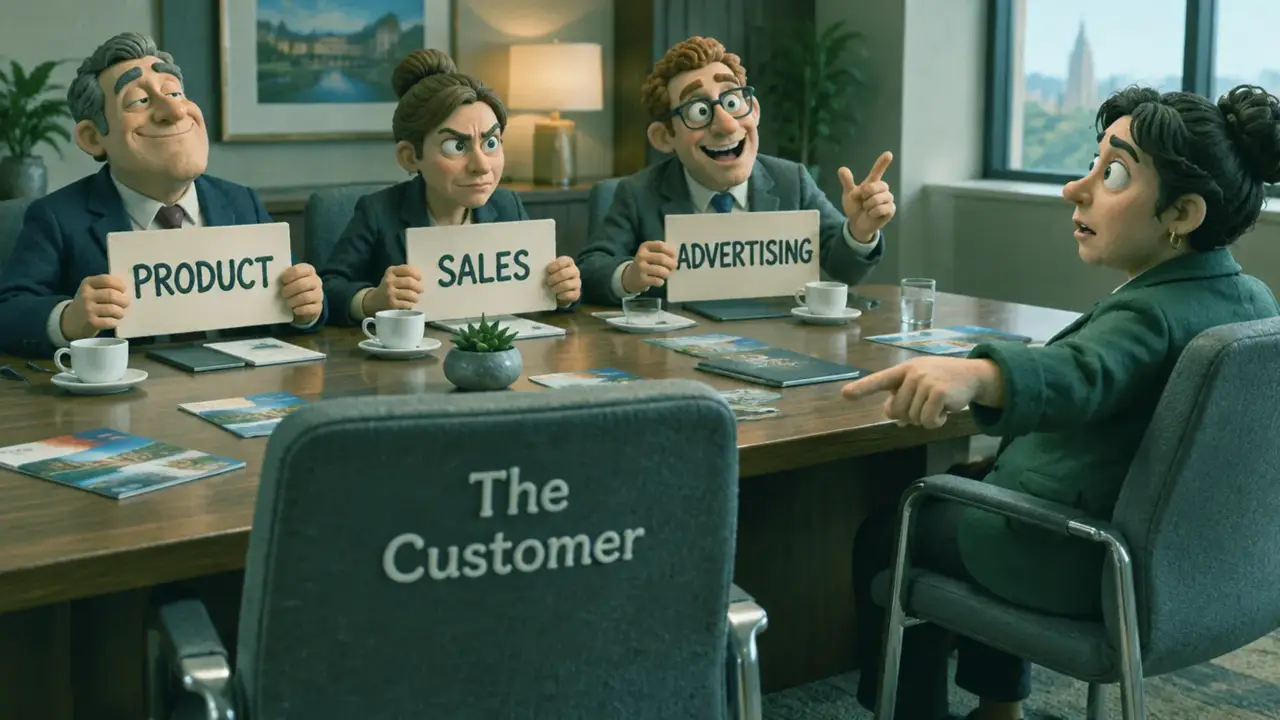
Ask almost any hospitality business whether it’s customer focused and the answer will be a resounding yes. Of course it is. We're in hospitality. Looking after people is what we do.
There’ll probably be something about exceeding expectations on the website, a collection of lovely reviews, perhaps a photograph of the team holding an award. Nobody is going to admit, “Actually, we tend to organise things around what suits us and hope our customers fit in.”
What a business says it cares about and what actually drives its decisions can be very different. You might deliver excellent service once someone arrives but, at the same time, make decisions with surprisingly little understanding of why they chose you in the first place.
This is where business orientation comes in. It’s the underlying outlook that shapes what you discuss in meetings, where your money gets spent and what people are expected to achieve. You'll not find it written down anywhere, but you'll recognise it in the way your business behaves.
In my Academy module on customer centricity, I look at four competing outlooks: product, sales, advertising and market orientations. As you read through them, think about your own business. Particularly what happens when bookings slow down, when your budgets get squeezed, or when somebody has an exciting idea for something new.
Which one sounds familiar?
Product orientated: “We’ve got a fantastic product.”
In a product orientated business, the starting point is what you have to sell. The rooms, the food, the facilities, the technology, the experience... A lot of time goes into improving it, adding to it and making sure everyone knows just how good it is.
You’ll probably recognise these conversations... We’ve refurbished the bedrooms, so we need a campaign. We’ve bought an enormous LED screen, so that needs to be on the front of the brochure. The chef has created a new menu, so get a photoshoot booked and tell everyone about it.
The assumption underneath it is that, if the product is good enough and people understand how good it is, they’ll buy it. Marketing’s job essentially becomes educating customers about the wonderful things the business has created. If you like, it's the "build it and they'll come" approach (for anyone old enough to remember Field Of Dreams).
I once worked in a venue’s entertainment department where the prevailing opinion was that we were there to educate people in music. That meant continually coming up with new and fashionable club nights for relatively small numbers of people to attend. Of course, what we were actually there to do was entertain people... which required an understanding of how they wanted to be entertained. Our enthusiasm for the music wasn’t the same thing as their enthusiasm for buying a ticket.
Now don't get me wrong. There’s nothing wrong with being proud of your product or investing in making it better. Product is the most important of the 4Ps of marketing after all. But “better” according to whom? A meeting planner might value a quick, clear proposal far more than they would another piece of impressive technology. A hotel guest probably prefers a decent night’s sleep far more than a complicated lighting system you spent a fortune to install.
So if your response to disappointing bookings or enquiry levels is to reach for something new, improve a feature or explain the product more enthusiastically, you might recognise yourself here.
Sales orientated: “We need more business on the books.”
In a sales orientated business, every conversation starts with a financial target. How much revenue do we need? How far behind are we? How many enquiries have converted? What can we do to get those bookings over the line?
In these businesses, marketing is largely there to support sales. It produces the collateral for the exhibition, tidies up the presentation, creates an offer for the quiet dates and sends an email because the sales team needs something to go out this week.
When business slows down, their response is usually to push harder. More calls, more follow-ups, more offers. Perhaps a discount will help, or an extra incentive, or another email to the database. There’s an intense pressure to sell what’s available, but with little time spent questioning whether the offer is right for the people receiving it.
Of course sales matter. But revenue on its own doesn’t tell you whether you’ve attracted profitable business, whether those customers are a good fit, or whether they’ll come back without another discount.
A heavily discounted conference booking might look good in your weekly report but might incur expensive staffing, displace better business, and leave very little profit. Getting it signed isn’t necessarily the same as getting it right. Remember - not all revenue is good revenue!
If your marketing priorities are usually dictated by this month’s revenue gap, or your team is expected to make whatever’s available look more appealing, this might be your business.
Advertising orientated: “We need to get our name out there.”
An advertising orientated business can look as though it takes marketing very seriously. There’s always plenty happening on the socials, plenty of videos, newsletters, campaigns, and a content calendar that leaves very little room for anyone to manage a lunch break.
The difficulty in these organisations is that marketing has become almost entirely about communication. Questions about who the business should serve, what those customers value and whether the offer meets their needs get much less attention than what they're posting on Thursday.
You’ll hear that we need more 'engagement', that we should be on another platform, or that we need a campaign to “raise awareness”. Success is usually reported through reach, impressions and clicks, often without much understanding of whether any of it is helping to create customers.
I'm not suggesting that advertising isn't important, and awareness may absolutely be the problem that needs solving. But you need to know that it’s the problem first. Customers might already know you exist and still have perfectly good reasons for choosing somewhere else.
If customers find your booking process difficult, your packages confusing or your proposition irrelevant, simply making more people aware of those things is unlikely to be the right answer. But the response to disappointing results seems to always be yet another campaign, leaving the marketers working harder to promote something that nobody has properly questioned.
If your business can tell you how often it posts but struggles to explain why customers choose it, you might recognise this one.
Market orientated: “What matters to the people we want to serve?”
A market orientated business starts by looking outwards. It wants to understand the people it could serve, what exactly they’re trying to achieve, what they value and what alternatives they might consider. That insight then informs the decisions the business makes.
Customer centricity is at the heart of this. 'Market orientation' means understanding the wider market and competition. It means making sure that different departments act on what the business learns and goes well beyond just getting the marketers to do a guest survey.
If we take the meeting planner who keeps chasing a proposal. A product orientated venue might send more information about every conceivable facility. A sales orientated venue might offer a discount to secure the booking. An advertising orientated venue might launch a campaign about its exceptional service.
But a market orientated venue investigates what’s making that decision difficult for them. Perhaps the planner needs a quick quote because they’re under pressure to get a budget approved. Therefore, the more useful response might be to change how enquiries are handled, how prices are presented and who has authority to provide an answer.
That requires sales, operations and revenue managers to work together... which is considerably harder than just putting “seamless service” in the brochure!
The same thinking applies to investment. Before adding another facility or launching a new package, the business asks whose needs it would meet and what evidence supports the decision. It gathers insight from customers, shares it across departments and changes things as a result.
It also accepts the first rule of brand management: you are not the customer. Your experience can help you ask better questions, but it doesn’t give you permission to answer them on someone else’s behalf!
Why this makes commercial sense
Being customer centric doesn’t mean agreeing to every request, giving everything away or forgetting about the people who work for you. The purpose is to build a business that customers value enough to sustain.
Research from Rohit Deshpande and John Farley found that stronger business performance was associated with customers judging brands to be more customer centric. And by "performance" they meant real indicators like profitability, growth and market share, not just vanity metrics. Crucially, they found that the business’s own assessments of their customer centricity rarely corresponded with the customer's assessment.
In other words, just declaring yourself 'customer focused' isn't a reliable indication that your customers agree with you!
Separately, John Narver and Stanley Slater’s 1990 study of 140 businesses found a substantial positive relationship between market orientation and profitability. These studies don’t mean every customer focused business will outperform every competitor in every situation, but they provide evidence that market orientation has a tangible commercial value.
In hospitality, the implication is fairly straightforward. Understanding what customers value gives you a better basis for deciding where to invest, rather than spending money on improvements that matter more internally than they do to guests. It can help you price an offer around its value to the customer, instead of automatically reaching for the discount drawer. Understanding why people leave, or what makes booking difficult, gives you a chance to address problems that another promotional email won’t fix.
So, which one are you?
You'll probably recognise a bit of yourself in all four. And the point of this isn’t to stop caring about product quality, sales or advertising. It’s to consider what guides those activities and which outlook wins when a difficult decision has to be made.
Think about your last significant investment. Was it based on evidence of what customers needed, or something the business wanted to offer? What about your last marketing meeting? How much time went into discussing customers, compared with discussing the things you wanted to sell and the content you needed to produce?
Then try to remember the last time that customer feedback genuinely changed a decision. Something meaningful like a package, a policy, an investment or the way different departments work together. If you’re struggling to remember, it probably tells you more about your business than the customer service statements on your website do.
Every hospitality business has customers and guests. But that doesn’t mean every hospitality business is organised around them.
You might be quite clear about which orientation you’d like to be, but the more revealing question is which one your customers would recognise?
Customer centricity is the starting point of my Hospitality Marketing Academy where I help hospitality marketers develop the knowledge and confidence to create more customers, not just more content. It’s CPD-accredited, HOSPA endorsed, and covers the strategic and commercial foundations of marketing, not just how to use the tools. You can join individually or enrol your whole team, with practical tools and flexible learning that fits around the day job. Find out more about the Academy.